Home

Thursday, October 9, 2014

Can the Trees Speak for themselves? The Protest of Mother Nature & The Protest of Humans: NYC Climate Rally


To go out into nature, is to see our Mother’s protest. She stands strong as she demonstrates her message; you are hypnotized as she distracts your senses.

The redundant croaks of the cicadas and the responses of the crickets pull your ears away. The calling of the blue jay echoes overhead and the hawk shouts “beware” as he lands below.

The squirrels fight with the birds for attention as they play tag. Around my sneakers and above the tree stump, they dodge all objects in sight. Only when they reach “safety” at the top of the pine can they relax. They push the dry leaves out of the way and you can hear the leave’s pleading as they try to hang on to the branches above.

But the sunlight above wins my attention as she points her rays below, and reminds the animals who is really in charge. Her arms light up the lake to fully reflect the scene above. A family of trees huddles together. Each tree is beautiful but with its own touch. The tallest pine, the oldest brother, I would suspect, peers over the rest to get a better view of them in the mirror below. Just underneath him, the ladies change into their finest reds as they sprinkle their leaves with a rosy glow. The fall ball is almost here! Old grandpa is a bit embarrassed by his balding branches as he remembers the result of the last lighting strike. The winds help him scratch his head to brush off the pestering hawk. No family trees are quite the same, though they all do spread far and wide around the lake.

This is just a taste of Mother Nature's protest. 

Her protest runs 365 days a year, always demonstrating the intrinsic beauty of nature.
Despite initial assumptions, her protest is not silent. On the contrary, if you let her, she will scream at your every sense. In many ways there is no way to replicate this phenomenon. This extraordinary omnipotent presentation reminds us who is in charge. Yet, in this day and age the sad reality stands that not everyone will take the time to listen to Mother Nature’s protest. And for this reason, we, the people who understand the importance of a clean environment have the obligation to pass on the message to those who don’t.

On September 21, I walked hand and hand with people who have experienced Mother Nature’s protest too. Together, we united in the streets of New York City for The People’s Climate March. If you are one of the people who have not seen, heard or felt the protest of nature then this human demonstration is for you. For the UN conference politicians who ponder the value of climate change legislation, this is for you. For anyone who doubts that people care, and are willing to speak up for what they believe in, this march is for you.

310, 000 people marched in the streets of Manhattan. This mass was made up of the smallest tot perched high on his dad’s shoulders to the great-grandmother who paraded the streets in her wheelchair. More commonly represented though were the thousands of students who had traveled from around the country to express what they wanted their future to look like. Students from Appalachian State held their anti-mountain top removal signs high; students from the UCs applauded the use of solar energy; the Pitt students marched to the beat of “frack is whack.” The untarnished grins of students, eager for change, contrasted the frustrated faces of the elders, desperate to go back to the good ol’ days.

But, no matter what the expressions were, the ultimate goal was clear- to shine a light on Mother Nature. To make so much noise, that people and politicians would wake up, and make a change. This noise came in all different shapes and sizes.

Visual noise was scattered about as posters conversed in the air. “Earth: Voted Most Livable Planet in 3.5 Billion years,” bragged a sign. “Climate Change isn’t cool!” responded another sign. “I’m doing something, your turn!” mocked yet another one. Al Gore and Tim DeChristopher both made an appearance. They were only out-fanned by the Lorax and the polar bear. People in bright colors, on stilts and in baby böerns all filled the streets. Every person in New York City had to have noticed.

Visual noise was only outperformed by audio noise. After a brief moment of silence, chaos broke out in a wave across the people. Trumpets played; symbols clapped; horns sang. In case the point wasn’t clear enough, people chanted “keep that oil in the soil,” and “hey Obama, we don’t need no climate drama.” The message was sent with voices, young and old, hopeful and fed-up, and will continue to be delivered as newspapers and talk shows marvel on the largest protest in decades. Does human demonstration mean anything anymore? I guess we will find out in the proceeding months. 

This march is a message that is coming from people who have experienced nature’s beauty and appreciate the complex system of ecology to people who have not yet experienced this. Nature’s Protest has been going on for 24 hours a day, for every day any human has been alive, but for those who have not taken the time to listen, we will do our best to convey the message to you.


Homo Sapiens are one of the many species who live on this planet. If you go out into the nature, you will see the family trees, the skittish squirrels, the running river, and plenty more. We are here as a last plea to go out into nature and let her tell you it for herself. But, if you won’t do that, then you must take our word. Nature is a beautiful production, and you must help us protect it. Help us reduce our enormous footprint. Help us go back to a simpler life. We humans, and the biosphere as we know it, don’t have much time.


Tuesday, September 23, 2014

Land of Buttercups

Today we stopped in the land of buttercups. The town of Nanortalik is only 1400, yet probably one of the bigger towns in Greenland. The people here greet us with smiles and follow us like dogs. We are some strange foreigners to them. They take pictures with us, and wonder where we come from.

The children run around in the gravel roads with their dogs chasing behind. If you don't watch out, they will jump on your backs. The land of buttercups is a calm one, but fragrant with colors. The yellow grounds are only matched in beauty by the small houses which radiate shades of blue and red. The reflections of the rainbow-colored villages dance along the water below. Only the call of the raven disturbs the peace which lays still on its bed of yellow flowers.

We, foreigners, peak through the small wooden cabins which are sometimes hidden by the wild flowers. The community may be small, but the history is intact- proudly preserved through photographs and letters. Just beyond, you stumble into the graveyard. There are a few tombstones remembering those who died, but slowly fading into the background, as the sea of yellow prospers. The immensity of life is slowly taking over the stumbling shadows of death. And with that lies the beauty of the land of buttercups.


Tuesday, August 5, 2014

Featured in Fairfax Times

http://www.fairfaxtimes.com/article/20140801/NEWS/140809814/arctic-expedition-provides-eye-opening-experience&template=fairfaxTimes

Arctic Wrap Up

For the past two and a half weeks, I traveled the Canadian Arctic and Greenland with the expedition group, Students on Ice.


There were 132 international participants, 86 students and 46 leaders, who embarked on our ship the "Sea Adventurer,” for a 16-day journey. We started in the northern Canadian village of Kuujjuaq, Nunavut, and made our way down the Labrador coast, visiting the extraordinary Torngat Mountains National Park. From there, we crossed the Labrador Sea and explored the abandoned villages and breathtaking glaciers of southern Greenland. 


Thirty students on board were Inuit, and shared with us what it was like to live in the North. As someone who had thought the North was only a place for polar bears and Santa Claus, I was in for a wake up call as I learned all about the aboriginal people and visited their vibrant northern communities. 

The staff, too, was not what I expected. Originally, I thought these adults would be all climate scientists, but it turns out that we had world-renowned leaders from many different professions.  There were musicians, artists, educators, entrepreneurs, and more! There was such a wide range of specialties within the staff, that there was always someone to answer my questions.  A question about birds- check. Fish-check. Rocks- check. How to play guitar- check. And those relationships will continue even after the trip. All these instructors brought something different to the table, and allowed for students to learn in different ways.

While some students expressed themselves most comfortably through discussion, others played music to express their thoughts and feelings about the Arctic.  

The places that inspired these discussions were unbeatable. Fjords, which painted the skies with mountains and the waters with humpback whales, were all about. The seas were so clear that you could see the Arctic char swimming below, and the water was so fresh that you could fill your water bottles underneath the waterfalls. 


We witnessed climate change as we visited glaciers where sea ice had receded a thousand meters in the last decade, and saw glaciers calving in front of us. We saw how the tree line and southern vegetation is expanding northwards, and bringing with it southern species of birds. We heard the stories of how the caribou decline is affecting the native people’s eating patterns.
 
Huddling in a small tent, we learned the stories of the elders. They told us what it was like to be forced out of their homes as kids when the Canadian government decided to condense the native people’s villages.

Throughout the two and a half weeks, this place which I once thought void of life became the epitome of life itself. There is no better feeling then sitting on a rock staring up at a glacier and realizing how small you actually are. The song of the birds and the pounding of the waterfall against the ground below was the only noise I heard.


Next year will be Student On Ice’s 15th anniversary. And although 80% of the students were able to be sponsored do to generous donors like my sponsor Climate One, next year SOI is hoping to reach its goal of 100% sponsorship. The US Embassy of Canada is upping the ante along with sponsors around the world to accomplish this goal. With that comes even more students getting to experience this once in a lifetime trip- entering as visitors leaving as lobbyists for the Arctic.


Thursday, July 3, 2014

Did you know the Electric Car is older than your grandma?


 The documentary Who Killed The Electric Car explores how a car most people consider brand new, has been around for much longer than we think. Even more, it explores why this avant-garde idea was pushed to the back burner.

The Original Electric Car: The GV1
A hundred years ago, more electric cars were used than gas vehicles.  Then, the automobile industry started to advertise gas guzzlers as sexy, fast cars, and those took off running. It wasn’t until the early 1990s, that electric vehicles rolled back into action. In efforts to control the horrendous air quality, The California Air Resources Board (CARB) passed the Zero Emissions Vehicle Mandate in 1990 which set targets on the number of electric vehicles California Car Companies had to produce. The EV1, introduced by General Motors (GM) in 1996 set precedent for a speedy and slick electric vehicle. 


However, the automobile industries that were creating electric vehicles were the same ones fighting the mandate. In a confidential 1995 memo, the American Automobile Manufactures Association wrote that they sought to hire a PR firm to create a “grassroots educational campaign” to repeal the mandate.  Even more shocking was the challenge they were fighting so hard to prevent: a “greater consumer acceptance of electric vehicles.” Companies like GM lobbied CARB to compromise the mandate, and ultimately ended up dismantling their electric cars and EV1 staff in 2001.


A EV1 Vigil after GM reports to take back cars
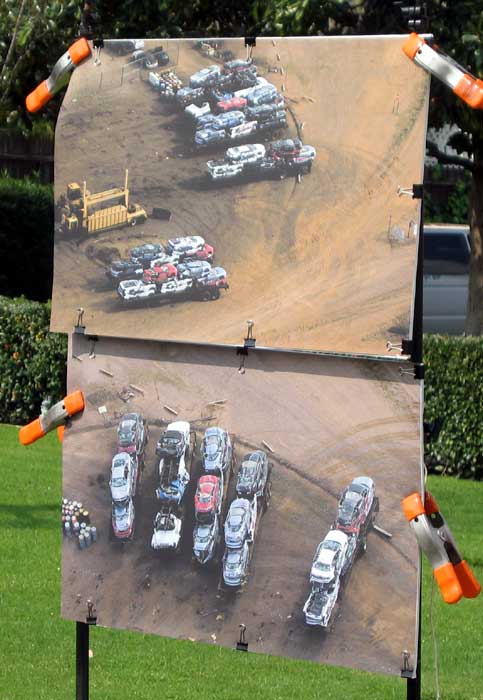
Even though people who had EV1s loved them, GM ultimately forced these people to give up their leases and took all their cars off the road. The film shows people begging to keep their beloved cars, and then flashes to GM taking the same cars to get crushed in the Arizona desert. Tom Everhart, who was on the GM board from 1989-2002, said that many people in the company didn’t believe the car could make a profit. Meanwhile, there were waiting lists 4,000 people long waiting to buy these cars. People loved them so much that there were vigils for the cars, when GM announced they were taking them away.

Some may blame the car as not being high-tech
Photos of crushed EV1s
in Arizona Desert
enough or able to drive far enough. However, Stan Ovshinsky proves those claims wrong. He created the Nickel Metal Hydride NiMH battery which energized the car to travel 120 miles per charge with speeds up to 80mph. But soon after GM bought Stan’s invention, the company went ahead and sold it to Texaco-Chevron Oil and Gas Company who further suppressed the efforts of the electric car.

This car’s journey has not been an easy one. It has found itself stuck in many potholes, and only now is it having the opportunity to get out. It is important for corporations and people to remember their mistakes, so the next great solution doesn't find itself stuck behind so many red lights.


Everything you need to know...